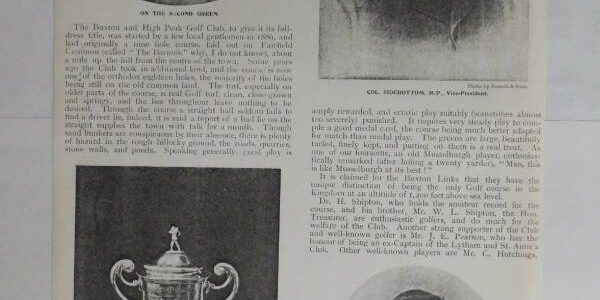
Buxton and High Peak Golf Club: Golf Illustrated – the first review On going through some old papers given to me recently, I came across this review of Buxton and High Peak Golf Club which was published in Golf Illustrated (11/08/1899).
I have reproduced the pages (which were old photocopies) as best I can and will now seek to acquire the original article if it is still available. I trust that any issues of copyright are addressed through this acknowledgement. Nevertheless, in spite of its age I think it is still quite legible and I encourage you to read it at your leisure. In the spirit of saving time, I draw your attention to number of points of interest (at least, I thought they were interesting).
To set the context, the Club will have been 13 years old at this time. This is the same year as the H.Varden beats J.White in the British Open (by 5 shots), the Gideon Society is founded, Carnation invents evaporated milk and Humphrey Bogart is born. Robert Bunsen (of burner fame) dies this year.
The world is about to be introduced to B&HPGC in this little review. Hooray! Page 1
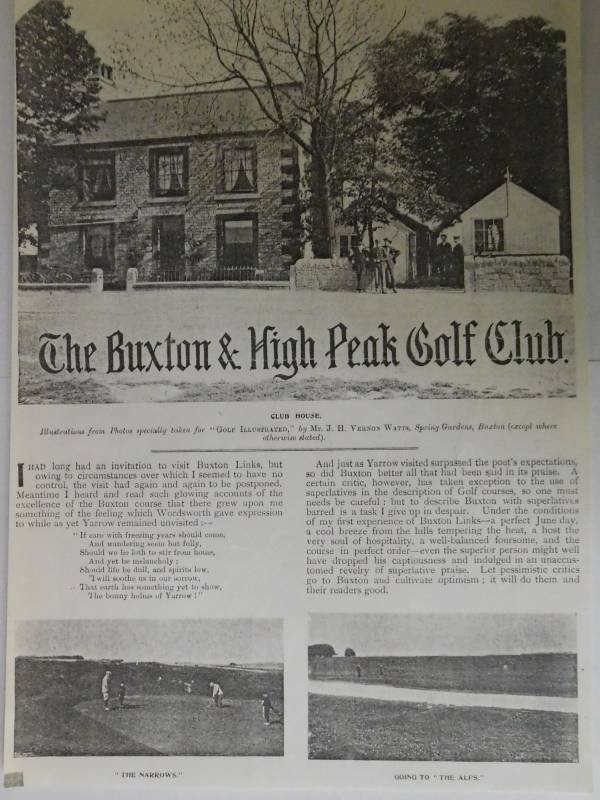
The typeface of the heading: what a wonderful gothic style.
The photograph of the Clubhouse was Fairfield Liberal Club (formerly Ash Cottage) on Town End, Fairfield. The Club was based there from 1892 – 1905. This is near to the site of the present Clubhouse, built in 1905 with money raised through the selling of Debentures. (The story of this fundraising is covered in an earlier article on this website).
The typeface of the heading: what a wonderful gothic style.
The photograph of the Clubhouse was Fairfield Liberal Club (formerly Ash Cottage) on Town End, Fairfield. The Club was based there from 1892 – 1905. This is near to the site of the present Clubhouse, built in 1905 with money raised through the selling of Debentures. (The story of this fundraising is covered in an earlier article on this website).
There are at least 5 men standing outside the Clubhouse: who were
they?
The Narrows and The Alps are almost devoid of trees.
they?
The Narrows and The Alps are almost devoid of trees.
William Wordsworth did indeed visit the River Yarrow (the “bonny holms” of Yarrow is a fine river in Chorley, Lancs) eventually, with it exceeding his expectations in both beauty and form; the expectations the author had were exceeded. I am interested in any other articles he wrote – did he have a lexicon of expletives? Not very often that the work of a renowned poet is used to introduce a Golf Club review these days.
The author experienced
1. A perfect June day
2. A cool breeze tempering the heat
3. A host who was the soul of hospitality
4. A well balanced fourball and
5. The course in perfect order.
Sounds like a normal day at Buxton and High Peak Golf Club!
1. A perfect June day
2. A cool breeze tempering the heat
3. A host who was the soul of hospitality
4. A well balanced fourball and
5. The course in perfect order.
Sounds like a normal day at Buxton and High Peak Golf Club!
Page 2
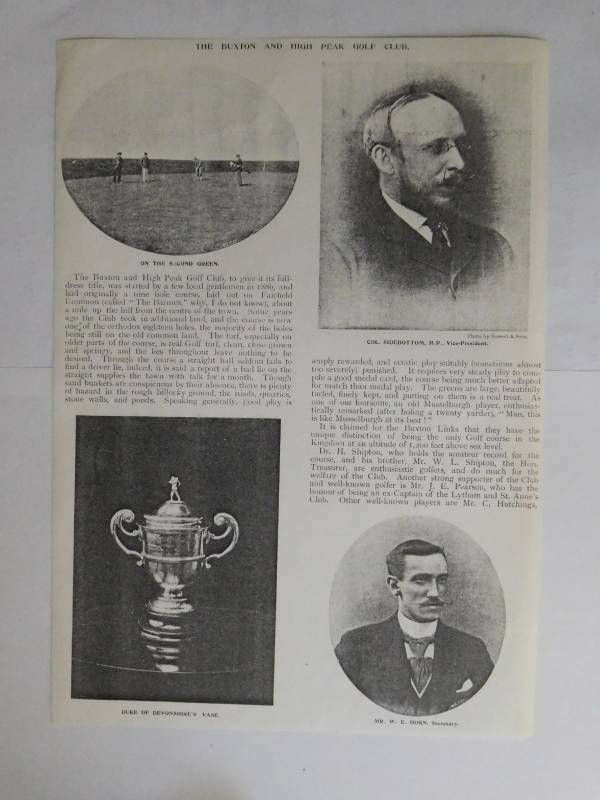
I am particularly impressed by the description of the turf: “clean, close grown and springy, with the lies throughout leaving nothing to be desired”.
I am particularly impressed by the description of the turf: “clean, close grown and springy, with the lies throughout leaving nothing to be desired”.
A limestone substrate still provides excellent drainage and grows great grass. This seems entirely reasonable, unlike the next claim that “a report of a bad lie on the straight supplies the town with talk for a month”. Not really sure about that!
The quarries, pond and hillocky round which still feature on this course 120 years later are a testimony to the historic activities in the High Peak – an area extensively mined over generations.
There is a reference to Mussleborough: this is the oldest continuously
played Golf Course in the world (1672). Really?
Any B&HPGC member will agree with the observation that erratic play is punished. This is a great course, but it presents challenges with the natural features and the prevailing wind: at 1200 ft, golfing here can be a bracing experience.
The quarries, pond and hillocky round which still feature on this course 120 years later are a testimony to the historic activities in the High Peak – an area extensively mined over generations.
There is a reference to Mussleborough: this is the oldest continuously
played Golf Course in the world (1672). Really?
Any B&HPGC member will agree with the observation that erratic play is punished. This is a great course, but it presents challenges with the natural features and the prevailing wind: at 1200 ft, golfing here can be a bracing experience.
The illustrations here are of the course as it was (barely recognisable without the trees) and of the suitably terrifying Colonel Sidebottom M.P., (Vice-President) and Mr W. Horn, Club Secretary. They present images of a particular type of golf club member and it is noted that this stereotypical image of the Victorian golfing gentleman is no longer applicable at this inclusive and friendly Golf Club.
There remains an annual competition for Duke of Devonshire’s Vase
(Cup).
There remains an annual competition for Duke of Devonshire’s Vase
(Cup).
Page 3
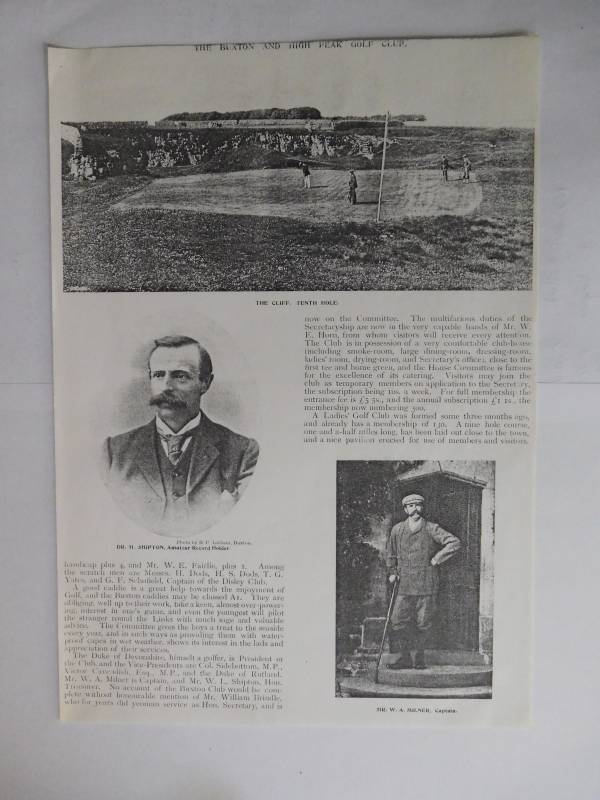
The Cliff (10 th hole) is much changed although the quarry face in the illustration will be familiar to all members now as a feature of the 11 th and 12 th holes. The rough steps leading down to the green appear to have made it necessary to leave golf bags at the top.
I particularly noted the recommendation to dine in the Clubhouse as it is known for the excellence of its catering. No change there!!
There is a reference to a Ladies Golf Club. I believe that this is the Club established in Burbage, a suburb of Buxton. This had a connection with B&HPGC in the years 1895 – 1900. However, records show that it was only from 1928 that a full Ladies Committee was formed and that there was a new extension added to the Clubhouse for their convenience. There has been a thriving Ladies Section ever since.
Caddies were usually recruited from Fairfield School. In 1895 a caddy master was appointed by the Club following reports of caddies running wild in their enthusiasm to earn a few pennies from visitors. Eeek! It appears that they were well trained and were rewarded with holiday treats and even waterproofs. Both girls and boys were caddies until 1900, from which time it was restricted to boys. Some of the more senior members of the club have reported learning golf by caddying in the 1930s.
The Cliff (10 th hole) is much changed although the quarry face in the illustration will be familiar to all members now as a feature of the 11 th and 12 th holes. The rough steps leading down to the green appear to have made it necessary to leave golf bags at the top.
I particularly noted the recommendation to dine in the Clubhouse as it is known for the excellence of its catering. No change there!!
There is a reference to a Ladies Golf Club. I believe that this is the Club established in Burbage, a suburb of Buxton. This had a connection with B&HPGC in the years 1895 – 1900. However, records show that it was only from 1928 that a full Ladies Committee was formed and that there was a new extension added to the Clubhouse for their convenience. There has been a thriving Ladies Section ever since.
Caddies were usually recruited from Fairfield School. In 1895 a caddy master was appointed by the Club following reports of caddies running wild in their enthusiasm to earn a few pennies from visitors. Eeek! It appears that they were well trained and were rewarded with holiday treats and even waterproofs. Both girls and boys were caddies until 1900, from which time it was restricted to boys. Some of the more senior members of the club have reported learning golf by caddying in the 1930s.
Page 4
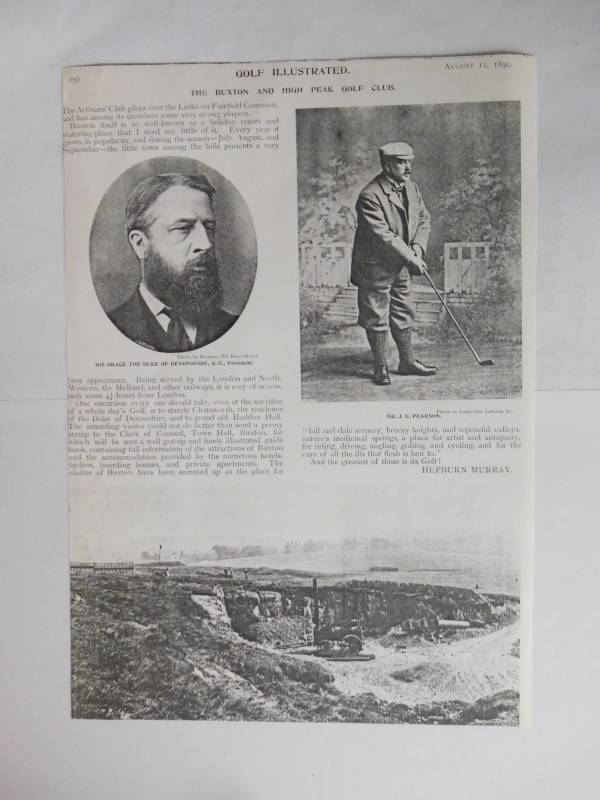
This begins with a very brief mention of the Artisan Section. This was open to local men who played golf and were willing to do some work on behalf of the club. Without doubt, the Artisan section has produced some of the finest golfers that have ever come from Derbyshire. (Please see another article on the Artisans).
I particularly note the enthusiasm shown for Buxton as a tourist destination. The 4hrs 45mins from London seems quite reasonable for 1899 (now it is about 3hrs 30mins by train via Stockport). However, I am intrigued that the author did not consider it worth mention the travel times from Sheffield or Manchester: is this evidence of a London bias?In conclusion, the article cites Buxton as a place for hill and dales scenery, breezy heights and reposeful valleys, nature’s medicinal springs, a place for artistry and antiquary, for riding, driving, angling, golfing and cycling and for cure of all the ills the flesh is heir to.
This begins with a very brief mention of the Artisan Section. This was open to local men who played golf and were willing to do some work on behalf of the club. Without doubt, the Artisan section has produced some of the finest golfers that have ever come from Derbyshire. (Please see another article on the Artisans).
I particularly note the enthusiasm shown for Buxton as a tourist destination. The 4hrs 45mins from London seems quite reasonable for 1899 (now it is about 3hrs 30mins by train via Stockport). However, I am intrigued that the author did not consider it worth mention the travel times from Sheffield or Manchester: is this evidence of a London bias?In conclusion, the article cites Buxton as a place for hill and dales scenery, breezy heights and reposeful valleys, nature’s medicinal springs, a place for artistry and antiquary, for riding, driving, angling, golfing and cycling and for cure of all the ills the flesh is heir to.
The greatest of these is its GOLF!
Buxton and High Peak Golf Club welcomes visitors!!
Have a look at our website and find out more!!!
https://www.bhpgc.co.uk/visitors-welcome
Buxton and High Peak Golf Club welcomes visitors!!
Have a look at our website and find out more!!!
https://www.bhpgc.co.uk/visitors-welcome
Jon White
May 2019
May 2019